by
by 
Indoor air quality HVAC trouble rarely starts with a dramatic breakdown. It shows up as dust on the vents, a stale smell at 3 p.m., rooms that never cool evenly, and a system running longer than it should.
For Austin homes, apartments, and businesses, the fix is not always a pricier filter. Airflow, duct leaks, dirty coils, moisture, and ventilation all need to work together.
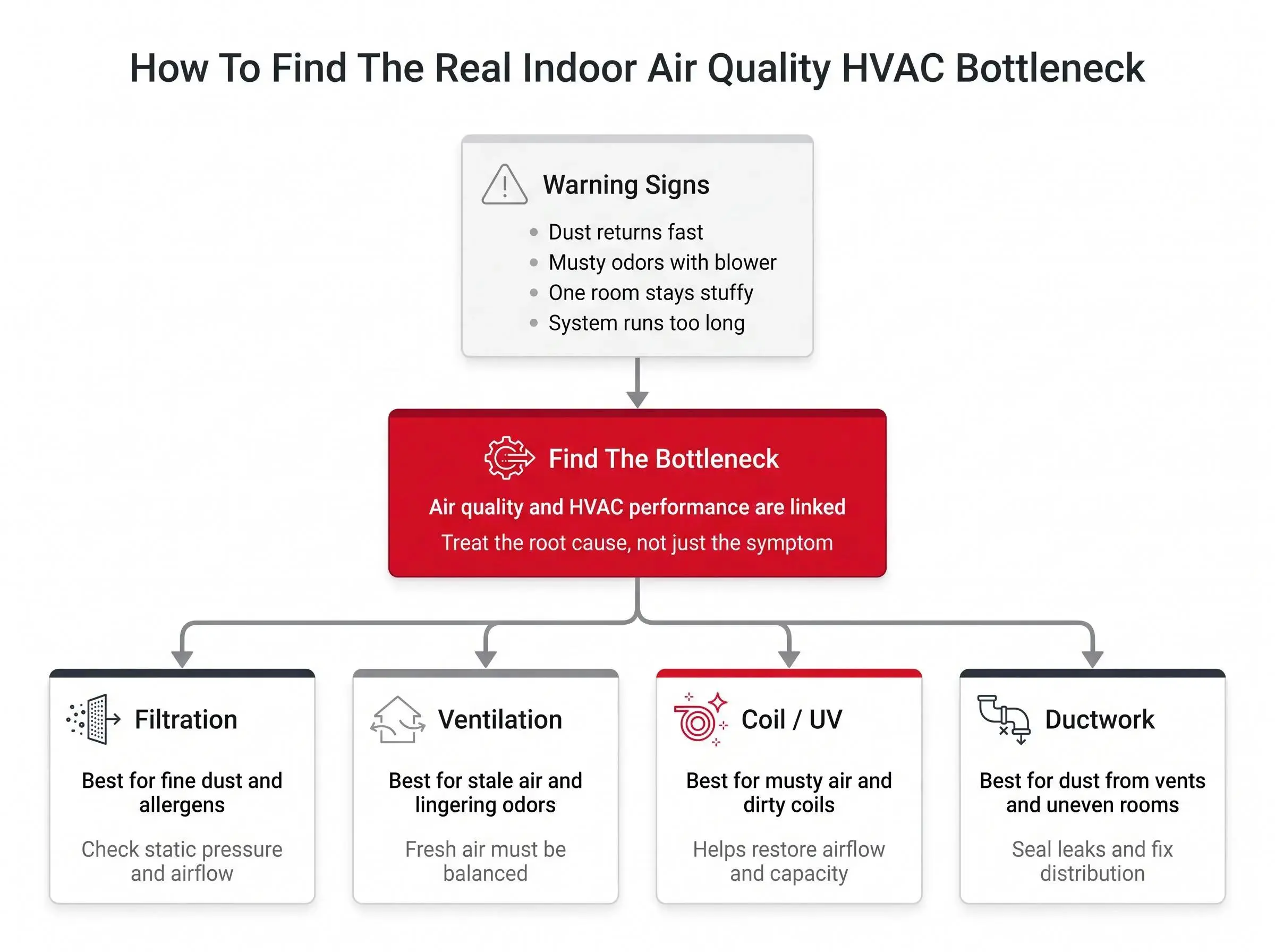
Start by noticing what your building is telling you:
- Dust returns fast after cleaning
- Musty odors kick on with the blower
- One room stays stuffy while others freeze
Find the bottleneck. Fix the air and the performance follows.
Why Indoor Air Quality and HVAC Performance Belong Together
Most people split these into two buckets. Air quality is what you breathe. HVAC is what heats and cools. In the real world, that split usually causes bad decisions.
Your HVAC system moves the same air you live or work in. It pulls it back, filters it, conditions it, and sends it through the building again. So when indoor air quality hvac problems show up, they rarely stay cosmetic. They turn into airflow problems, comfort complaints, longer run times, and equipment strain.
A few common examples tell the story fast:
- Dusty rooms often point to weak filtration, duct leakage, dirty blower parts, or a return side problem
- Musty odors usually don’t come from nowhere. They often trace back to moisture, stagnant air, or buildup on the indoor coil
- Hot and cold spots can mean clogged filters, poor duct layout, restricted airflow, or an imbalanced system
- Higher utility bills can show up when coils are fouled, static pressure rises, or the system has to run longer just to catch up
That’s the part people miss. Better air and better system output often come from the same fix.
A tighter filter, for example, might help with dust. It might also hurt airflow if the system can’t handle the added resistance. A ventilation upgrade might freshen stale air, but if it’s planned badly, it can add load and humidity problems. Good indoor air quality hvac upgrades are matched to the blower, the ducts, and the building. Bad ones are just expensive guesses.
If the air feels bad and the system feels tired, treat that as one conversation.
The Warning Signs Your Building Needs More Than a Basic Filter Change
Some issues really are simple. A dirty filter, a missed tune-up, a drain problem. But there are patterns that usually mean the problem runs deeper than swapping in another disposable filter from the hardware store.
Here are the signs we take seriously:
- Dust shows back up right after cleaning
- The air feels stale even when the system is running
- Odors return after cooking, pets, cleaning, or a busy day in the building
- Allergy irritation gets worse indoors
- Supply vents push visible debris or dust when you’re trying to reduce dust from vents
- Certain rooms stay clammy, stuffy, or hard to cool
- The system seems to run forever during Austin’s long cooling season
One complaint by itself may not mean much. Two or three together usually do.
If you’ve got recurring comfort issues and air quality complaints at the same time, don’t assume the filter is the hero of this story. A disposable filter can’t fix leaking ducts, dirty coils, bad return design, or an oversized fresh-air problem.
The impact is different depending on the space, but it’s real either way. In homes, people notice odors in bedrooms, more dust on furniture, worse sleep comfort, and allergy triggers that never quite settle down. In businesses, it shows up as complaints, uneven temperatures, stale conference rooms, and that low-grade occupant frustration nobody wants to own but everybody feels.
People spend a lot of time indoors. More than most owners like to admit. If the building air is off, it leaks into comfort, focus, and day-to-day livability pretty quickly.
Start With Filtration: HVAC Air Filtration Options and Their Tradeoffs
Filtration is usually the first place people look, and that’s not wrong. It just isn’t always the last fix you need.
The basic hvac air filtration options break down like this:
- Standard disposable filters handle larger particles and basic equipment protection
- Higher-efficiency media filters do a better job with fine dust and allergens
- Premium integrated filtration can make sense as part of a broader air quality plan
That’s the clean version. The messy part is airflow.
A filter works by catching particles, but every filter also adds resistance. In HVAC terms, that resistance shows up as static pressure. If static pressure climbs too high, the blower has to work harder to move air. Airflow drops. Comfort drops with it. In some systems, you end up trying to clean the air while quietly choking the equipment.
We’ve seen plenty of buildings where someone installed the highest-rated filter they could find and then wondered why airflow got weak by the second afternoon.
How to think about filter upgrades
A better filter is usually worth considering when:
- dust and allergens are the main complaint
- the duct system is in decent shape
- blower performance and airflow are already acceptable
A filter upgrade is less likely to solve the whole issue when:
- odors are the main complaint
- moisture is involved
- biological growth is suspected
- one side of the building gets poor airflow
There is also an energy tradeoff. Higher-efficiency filtration can create a real energy penalty when pressure drop gets too high. So no, the highest filter rating is not automatically the smartest choice.
The practical move is simple: pair any filter upgrade with an airflow and static pressure check. Otherwise you’re guessing.
When a Whole-Home Air Purifier Is Worth It
A whole home air purifier makes sense when standard filtration isn’t enough and you want the whole ducted system working on the problem, not just one room.
It treats air as it moves through the HVAC system. That’s the big difference from portable room units. Instead of chasing one bedroom, one office, or one corner of the house, you’re improving air treatment across the conditioned space.
That matters when the problem is building-wide, not local.
A whole home air purifier is usually worth discussing when you have:
- fine dust that keeps coming back even with regular filter changes
- lingering odors or airborne irritants
- occupants who are sensitive to particulates
- a house or business where comfort and cleanliness need to improve across the entire system
For people researching air quality products for home, this is often the fork in the road. Do you want three or four plug-in devices scattered around the place, or do you want one coordinated solution tied into the equipment already moving the air?
That said, a purifier is not a repair for everything.
What it won’t fix
- duct leakage
- dirty evaporator coils
- bad ventilation design
- airflow problems caused by poor duct layout
Performance also depends on sizing, installation, and how well the purifier is integrated with the existing system. That’s not small print. That’s the job. Whole-home purifiers are a recognized upgrade category for measurable air improvement, but only when the rest of the system gives them a fair chance to work.
If you know the symptom but not the purifier type, that’s the moment to get the HVAC side evaluated first.
Ventilation Upgrades That Bring in Fresh Air Without Overworking the System
Filtration handles particles. It does not remove the feeling of old air in a crowded room.
When air feels stale, odors linger, or occupancy runs high, ventilation becomes the real issue. That’s where balanced ventilation and HRV or ERV systems come in. They bring in outdoor air and exhaust indoor air, while recovering part of the energy from the air leaving the building.
That last part matters more than people think. Fresh air is good. Fresh air dumped into a system with no plan can punish your cooling bill.
Why better ventilation can help without wrecking efficiency
HRV and ERV systems improve fresh air delivery much more intentionally than opening windows or hoping leakage around the building envelope will do the job. They can reduce stale air and moisture-related problems while lowering the heating and cooling burden compared with rougher ventilation approaches.
The numbers from real projects are hard to ignore:
- one hotel ERV project cut annual HVAC energy use by 34 percent compared with conventional ventilation
- one office retrofit improved ventilation design enough to reduce the main cooling system from 20 tons to 10 tons
- other redesigns have cut required outdoor air from 4,770 CFM to 1,500 CFM, and school retrofits have reduced it by 65 to 70 percent, avoiding major equipment additions
Those aren’t reasons to copy someone else’s system. They’re proof that ventilation design affects cost, load, and equipment scope in a very real way.
For Austin projects, better indoor air quality Austin upgrades have to account for cooling load, humidity, and local code requirements. In other words, don’t treat fresh air as a simple add-on. Plan it or pay for it later.
UV and Coil-Cleanliness Upgrades That Restore Lost Capacity
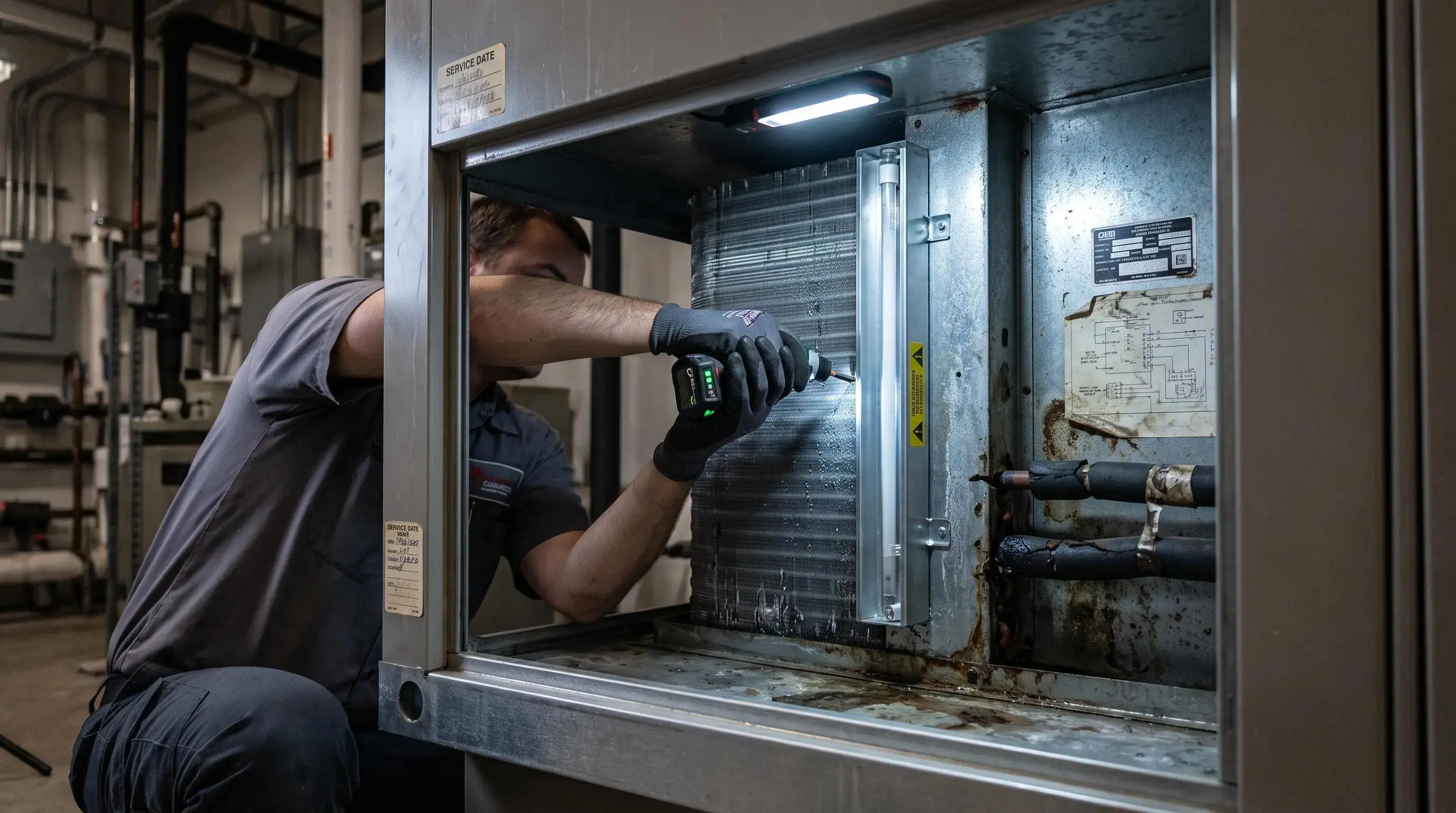
If your indoor coil is dirty or biologically contaminated, the system loses more than cleanliness. It loses performance.
A fouled coil reduces heat transfer, restricts airflow, raises pressure drop, and can feed odors that seem to come and go with system operation. Wet surfaces inside the air handler are especially prone to this. When musty air shows up right as the fan starts, we pay attention there first.
UV sterilization has a place here. It’s one of the recognized IAQ technologies used in whole-home systems, and it can support cleaner coil surfaces where buildup is the actual problem.
Where UV makes sense
UV upgrades are usually most relevant for:
- systems with recurring biological growth on indoor coils
- buildings with musty odors tied to the air handler
- commercial equipment that runs long hours and stays vulnerable to dirty-coil losses
In one commercial retrofit, adding UV-C to a fouled air handler was followed by a 43.7 percent airflow increase and a 48.3 percent drop in pressure resistance, with cooling capacity coming back close to design levels. That’s a serious recovery.
Still, UV is not magic. It won’t replace filtration. It won’t fix duct leaks. It won’t solve ventilation issues.
UV works best when you’re solving coil contamination, not when you’re hoping one device will clean up a neglected system.
Pair it with routine inspection and coil cleaning. That’s where it earns its keep.
Ductwork Problems That Keep Recontaminating the Air
A lot of people trying to reduce dust from vents are really dealing with duct problems, not filter problems.
Leaks on the return side can pull dust and contaminants into the system. Poorly sealed supply ducts waste conditioned air into spaces that don’t need it. Bad layout, crushed runs, or undersized branches can leave rooms starved for airflow even when the equipment itself is fine.
This is where indoor air complaints and performance complaints start to overlap hard.
A few clues help narrow it down:
- If dust is strongest near supply registers, inspect the ducts and the registers, not just the filter
- If one area stays uncomfortable, check airflow distribution before buying another air cleaner
- If the air smells dirty when the fan kicks on, inspect the air handler and ducts together
No purifier or premium filter can fully overcome major duct leakage. It just can’t.
When delivered airflow never reaches the intended rooms, the system runs longer to make up for lost ground. Bills go up, comfort stays uneven, and the air often stays dirtier than it should. If inspection shows the duct system itself is the bottleneck, Ductwork Installation & Replacement may be the right move. Not glamorous, but sometimes it’s the fix that actually changes the building.
How to Match the Right Upgrade to the Problem You Actually Have
This is where people either save money or waste it.
The right upgrade depends on the symptom, the root cause, and whether the issue is isolated or stacked with two other problems. Most buildings don’t need every IAQ product available. They need one or two well-matched corrections.
Use this as a starting map:
Fine dust and allergies
Start with filtration and duct inspection.Persistent odors or stale air
Look at source control first, then ventilation.Musty air or suspected biological buildup
Inspect coils and air handler surfaces. Consider UV where it fits.Uneven airflow and comfort
Check static pressure, blower performance, and duct distribution.High bills plus air quality complaints
Assess the whole system, not one component.
Some homes only need better filtration and maintenance. Others need filtration, duct sealing, and ventilation working together. Commercial spaces often need a broader ventilation review because occupancy and operating hours change the equation fast.
A good rule: start with the highest-likelihood root cause and favor upgrades that improve both air quality and HVAC performance. Don’t buy a pile of air quality products for home before confirming what your system can actually support.
If symptoms overlap or keep returning, get a professional assessment. That’s usually cheaper than three rounds of trial and error.
| Problem | Start with | Notes |
|---|---|---|
| Fine dust and allergies | Filtration and duct inspection | Start with the highest-likelihood root cause and avoid unsupported add-ons. |
| Persistent odors or stale air | Source control, then ventilation | Ventilation is the next step after source control. |
| Musty air or suspected biological buildup | Inspect coils and air handler surfaces | Consider UV where it fits. |
| Uneven airflow and comfort | Check static pressure, blower performance, and duct distribution | Focus on airflow diagnosis before buying more IAQ products. |
| High bills plus air quality complaints | Assess the whole system, not one component | Some buildings need combined fixes such as filtration, duct sealing, and ventilation. |
What to Check Before Installing Any IAQ Upgrade in Austin
The best upgrade is the one that works with the system you already have. Not against it.
Before making a major change, the equipment size and airflow picture need to make sense. Proper HVAC sizing depends on detailed load calculations, especially if the project affects ventilation, filtration resistance, or total system demand. Skipping that step is how good ideas turn into comfort problems.
Whole-home purifiers, HRV or ERV ventilation, UV sterilization, and premium filtration can all be integrated with existing HVAC. But integration should be planned, not assumed.
Ask these questions before you approve anything:
- Will this upgrade change static pressure or delivered airflow?
- Does my current equipment have the capacity to support it?
- Will the ducts need sealing, resizing, or balancing?
- Could this trigger permit or testing requirements in Austin?
Local mechanical and energy rules can affect ventilation and HVAC alteration projects, and some jobs may require testing by authorized energy-code testing contractors. You don’t need to become a code specialist overnight. You do need an installer who already treats that as part of the job.
If you know you need help but don’t yet know whether the answer is filtration, ductwork, or ventilation, our HVAC Services team is the right starting point. That’s exactly the kind of system-level diagnosis we handle for Austin homes and businesses.
Maintenance Is What Protects the Upgrade You Paid For
An IAQ upgrade doesn’t stay effective on its own. If the system underneath it gets dirty, drifts out of adjustment, or starts moving air poorly, the upgrade loses value.
Routine care should include:
- cleaning coils and major components
- inspecting electrical systems
- checking refrigerant levels
- testing thermostat operation
- evaluating overall system performance
Those are not box-checking tasks. Clean coils support airflow and help with odor control. Correct refrigerant and airflow help manage humidity and comfort. Regular inspection catches filter issues, drain problems, and small performance losses before they show up as stale air or long runtimes.
Austin makes this more important because cooling season drags on. Systems work hard for long stretches, and neglected equipment usually tells on itself by midsummer.
If your complaints are tied more to upkeep than to replacement, Air Conditioning Maintenance is often the next step that makes the biggest difference. Maintenance protects airflow, efficiency, and cleaner indoor living. That’s the real point.
What Homeowners and Businesses Should Expect From a Good IAQ Conversation
A good IAQ conversation should feel like diagnosis, not a sales pitch.
If a contractor jumps straight to a product without asking about symptoms, airflow, odors, dust patterns, or occupancy, that’s a miss. A credible recommendation should start with the problem and work toward the upgrade.
You should expect:
- a real discussion of what you’re noticing
- inspection of filters, ducts, coils, and airflow
- a plain explanation of tradeoffs between filtration, ventilation, purification, and duct improvements
- sizing or load-calculation review if the project materially changes system operation
For homeowners, better air should feel practical and attainable, not like a menu of gadgets. For businesses, the stakes are broader. Indoor air decisions can affect occupant comfort, operating costs, and retrofit scope, especially in spaces with long operating hours or uneven occupancy.
If the issue reaches beyond a single suite, storefront, or comfort complaint, our Commercial HVAC Services team is usually the right path. Building-wide air quality problems are often building-wide mechanical problems in disguise.
Why Measuring Airflow Matters Before Buying an IAQ Upgrade
A system can look fine on paper and still deliver something different in the building. In the EPA’s Building Assessment Survey and Evaluation study, direct measurements in office spaces found gaps between design intent, actual outdoor-air delivery, and routine verification. That makes airflow measurement more than a technical extra when ventilation, filtration, or comfort complaints are part of the job.
| Finding | Share (%) |
|---|---|
| Systems below designed outdoor airflow (among those with design data) | 40% |
| Buildings reporting no HVAC testing and balancing | 44% |
| Ventilation measurements below 20 cfm per person | 17% |
These results come from large, mostly mechanically ventilated office study spaces—not Austin homes or a prediction of any one building. The percentages also use different denominators, so they should not be added together. Still, the pattern supports a practical buying question: ask whether the contractor will measure delivered airflow and compare it with the system’s intended operation, rather than assuming an IAQ product alone resolves the problem. EPA’s BASE study summary describes the measurement methods and findings.
Conclusion
Indoor air quality hvac upgrades work best when they improve both what people breathe and how the system performs. That is the center of the whole conversation.
Start with the symptom. Confirm the root cause. Then choose the upgrade that fits the equipment, the ductwork, and the way the building is actually used.
If you’re dealing with dust, odors, weak airflow, or rising cooling costs in Austin, don’t keep layering guesses onto the system. Start with a professional evaluation and find the real bottleneck. That’s how you get cleaner air, steadier comfort, and equipment that stops fighting itself.