by
by 
When a fridge warms up or a dryer quits, most people guess wrong. With appliance repair Austin calls, the real question is whether you have one failed part or an appliance that’s done.
What matters is the symptom behind the symptom: leaks, breaker trips, soft food by noon. You need a real diagnosis before you replace something fixable or let a small problem turn expensive.
Start here:
- Warm fridge or dead ice maker does not always mean replacement.
- Leaks and drain problems often come from seals, pumps, or clogs.
- Burning smells and repeat shutdowns mean stop guessing and act fast.
What Counts as Residential Appliance Repair in Austin
When most people search for appliance repair Austin, they’re not talking about a toaster or coffee grinder. They mean the machines that keep the house moving every day, the ones tied to food, laundry, cleanup, and basic routine.
In plain terms, residential appliance repair is the diagnosis and repair of major household appliances used in the kitchen and laundry area. This guide is about in-home household appliance repair, not countertop gadgets and not full replacement projects where the old unit is simply removed and swapped out.
The category usually includes:
- Refrigerators and freezers
- Ovens, ranges, and cooktops
- Dishwashers
- Washing machines
- Dryers
- Microwaves
A lot of homeowners assume a broken appliance means the whole unit has failed. Usually, that’s not how it goes. Many service calls come down to a failed sensor, a worn seal, a clogged drain path, a bad switch, a control problem, or a motor component that’s no longer doing its job.
That’s why symptoms can be misleading. A dishwasher that stops mid-cycle might have a latch issue, a drain issue, or a control issue. A fridge that’s warm might be airflow, thermostat, coils, or something much more expensive. Same symptom, different repair path.
That’s also why same-day help matters. If the refrigerator quits on a Tuesday afternoon or the washer leaks the night before school uniforms need to be cleaned, you’re not just dealing with inconvenience. You’re trying to stop the problem from spreading into food loss, floor damage, or a completely derailed week.
Most Major Appliances Can Be Fixed, but Not Every Repair Is the Right Repair
Most common appliance failures are repairable, especially if you deal with them early. That part should take some pressure off.
Still, repairable and worth repairing are not the same thing.
A repairable problem usually means one failed part or one clear system issue. That might be a thermostat, igniter, door seal, control board, drain pump, belt, switch, or clog. These are normal breakdowns. They’re frustrating, but they’re not unusual.
Replacement-level problems are different. That’s where you start seeing severe compressor failure, widespread corrosion, repeated breakdowns across multiple systems, or parts that are hard to source and hard to justify paying for. At that point, you’re not restoring reliability so much as buying time.
Here’s the operator view:
The goal isn’t to save every appliance. The goal is to make the smart call before the appliance costs you twice.
Pay attention when you notice:
- Unusual noises that weren’t there last week
- Weak cooling, weak heating, or weak drying
- Water where water shouldn’t be
- Breaker trips
- Burning smells
- Repeated failure to start or finish a cycle
Those warning signs matter because secondary damage is where the bill gets ugly. A small leak becomes cabinet swelling. A hot-running dryer becomes a vent restriction problem. A struggling fridge runs constantly and wears the rest of the system harder.
When people search major appliance repair near me, they’re usually looking for fast clarity as much as the repair itself. They want somebody to tell them, plainly, whether this is a reasonable fix or a money pit. That’s where a licensed appliance technician earns their keep.
Refrigerators and Freezers: What Can Often Be Fixed
Refrigerator and freezer calls get urgent fast. Once food temperature starts climbing, nobody wants a long debate.
The good news is that many refrigerator and freezer problems are fixable. We regularly see issues that feel catastrophic to the homeowner but come down to targeted repairs.
Common repairable problems include:
- Not cooling properly
- Running constantly
- Frost buildup
- Water leaking onto the floor
- Ice maker not working
- Water dispenser problems
- Doors not sealing tightly
- Clicking, buzzing, or rattling sounds
A recent Consumer Reports member survey illustrates why diagnosis matters before assuming a compressor failure: 49% of new refrigerators purchased since 2015 had experienced at least one problem, including ice-making or compressor issues. Among refrigerators with icemakers, the estimated five-year problem rate was 31%. The survey identifies icemakers and water/ice dispensers as the two most commonly reported issues, while major cooling and compressor problems were less frequently reported. That makes an ice or dispenser failure a reason to troubleshoot—not, by itself, a reason to replace the refrigerator. Read the survey methodology and results.
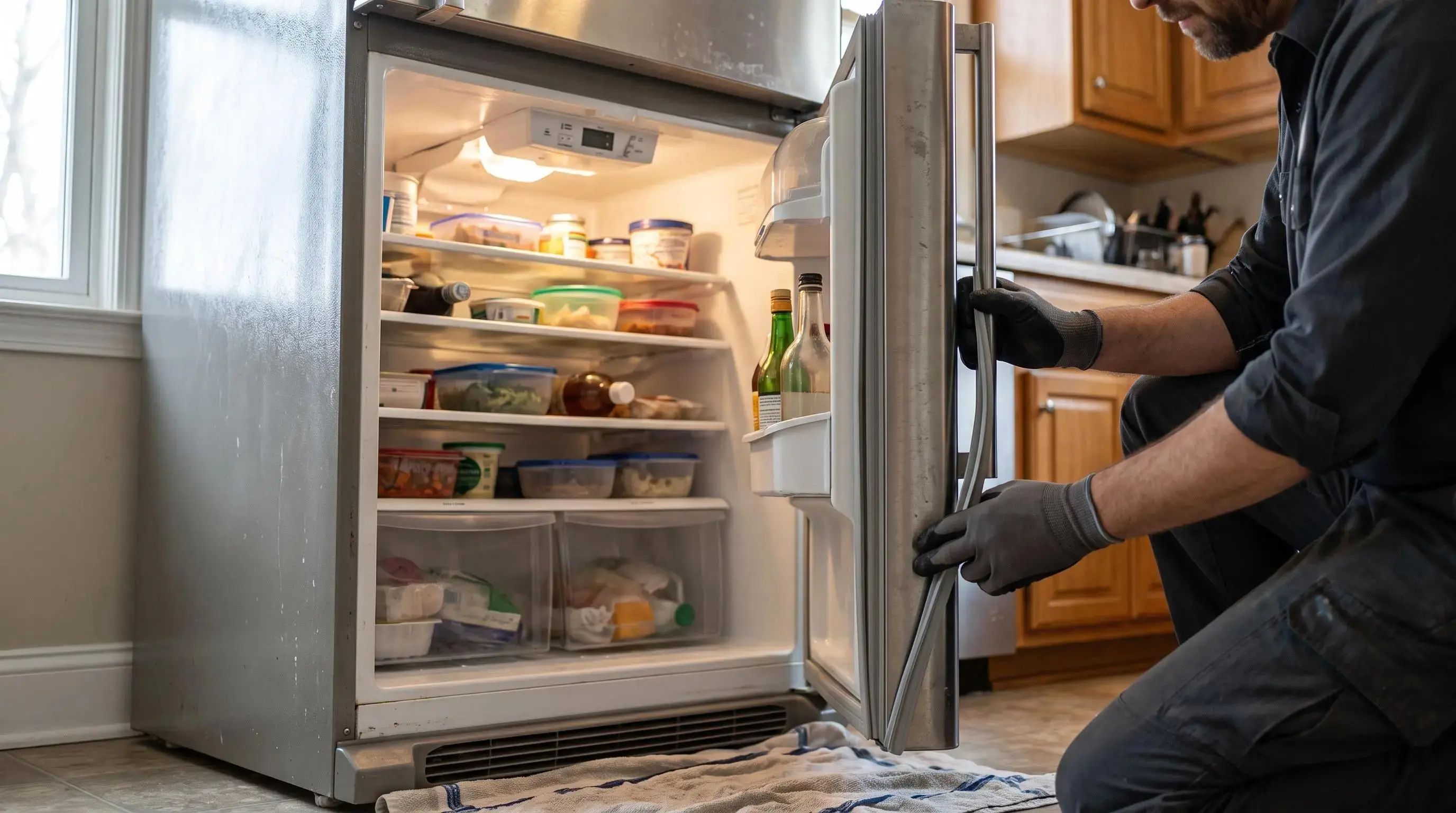
A few of the usual repair categories are pretty straightforward. Water filter replacement can restore pressure or improve ice and water performance. Door gasket repair can stop cold air loss. Ice makers often need troubleshooting or part replacement rather than full refrigerator replacement. Thermostat and control issues can also mimic much larger failures. Even basic coil cleaning and airflow service can make a struggling refrigerator behave normally again.
A warm fridge does not automatically mean a dead fridge. We say that a lot because homeowners understandably jump straight to worst case.
But compressor failure is different. That’s one of the costlier refrigerator repair scenarios, and it often triggers a serious repair-versus-replace conversation. If the sealed system is involved, the stakes change.
Refrigerator work can also require added technical qualifications when refrigerant handling enters the picture. If a repair involves refrigerant, homeowners should confirm the technician has appropriate EPA certification before that work is done. That’s not paperwork for the sake of paperwork. It’s tied to safe handling and proper repair standards.
There’s one Austin-specific detail worth knowing. Certain small self-contained refrigeration systems may be exempt from a city building permit under specific refrigerant and motor limits, but code compliance still matters either way. Exempt from permit doesn’t mean casual.
Ovens, Ranges, Cooktops, and Microwaves: What Can Be Fixed Safely
When the main cooking appliance goes down, the whole kitchen gets awkward in a hurry. That matters more than people admit, especially in homes that actually cook during the week.
A lot of cooking appliance problems are repairable, including:
- Oven not heating evenly
- Burner not igniting
- Electric element not heating
- Temperature running too hot or too cold
- Control panel not responding
- Microwave not heating
- Door switch or latch problems
Most of these trace back to a handful of systems:
- Ignition components
- Heating elements
- Thermostats and temperature sensors
- Switches, relays, and electronic controls
- Door-related safety parts
The part homeowners often miss is that symptoms are not diagnoses. An oven that won’t heat could be the igniter, the bake element, the sensor, or the control. A microwave that powers on but doesn’t heat may have a deeper electrical component problem, and that is not something to treat like a weekend DIY project.
Gas and electrical cooking appliances deserve respect. Repeated ignition failure, breaker trips, or a gas smell are not “see if it fixes itself” problems.
In Austin homes with gas or other fuel-burning appliances, carbon monoxide detectors are required and should be installed and maintained in the proper sleeping-area locations. That’s broader than just the kitchen, but it becomes very relevant when a gas appliance starts acting up.
Short version: if it sparks, trips, or smells wrong, stop guessing.
Dishwashers: Leaks, Drainage Problems, and Wash Performance Issues
Dishwashers are often highly repairable because the failure is usually tied to one moving part, one seal, or one blockage. They don’t always die all at once. They usually complain first.
The common issues are familiar:
- Standing water after a cycle
- Water leaking from the door or underneath
- Dishes coming out dirty
- Unit not starting
- Unit stopping mid-cycle
- Grinding or humming noises
A proper household appliance repair visit will usually focus on a few likely zones. Drainage restrictions are common. So are pump issues, worn door seals, spray arm problems, latch failures, and inlet or control issues. Poor cleaning performance can also come from very specific faults rather than general machine age.
Here’s where people lose time: they keep rerunning the cycle. If there’s standing water or an active leak, that delay can damage cabinetry, flooring, and even the subfloor below. A dishwasher leak is small until it isn’t.
A single leak or drainage issue is often worth diagnosing. Repeated leaks combined with rust, chronic poor cleaning, or broader decline shift the math. At that point, we’re not just talking about one repair. We’re talking about whether the machine is still a dependable part of the kitchen.
Washers and Dryers: The Laundry Problems That Are Often Repairable
Laundry appliances don’t break at a convenient time. It’s usually midweek, mid-routine, with a wet load trapped in the washer or a dryer that takes two cycles to finish one basket.
Washers often come in with complaints like:
- Not spinning
- Not draining
- Excessive vibration
- Water leaking
- Not filling correctly
- Bad odors tied to drainage or maintenance issues
Dryers usually show up with problems like:
- No heat
- Long dry times
- Drum not turning
- Loud squealing or thumping
- Unit shutting off unexpectedly
These symptoms often point to very repairable causes. Washers may need drain pump work, hose correction, or a lid switch replacement. Dryers often involve heating elements, thermostats, belts, rollers, or motor-related wear. And long dry times are frequently tied to vent restrictions, which is one of the most overlooked causes because the dryer still technically runs.
That’s the non-obvious part. A dryer that runs but takes forever is still failing.
Laundry appliances usually give warning signs before full failure. Early repair can prevent water damage, clothing damage, and in the case of dryers, overheating risk. Severe shaking, electrical smells, or repeated breaker trips should move the call up your list immediately.
When Repair Stops Making Sense
This is the real question behind almost every service call: is this worth fixing?
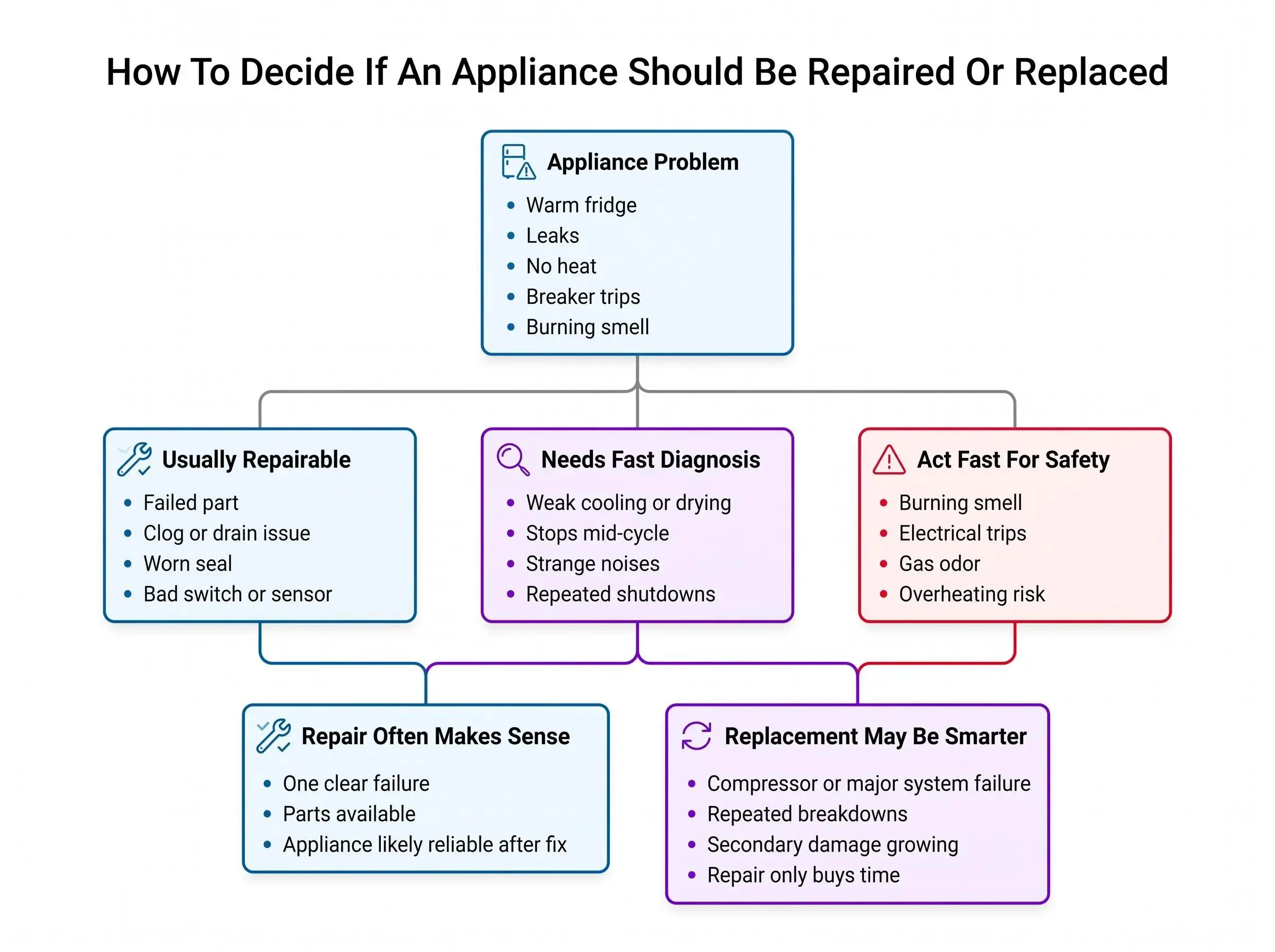
There isn’t one magic rule, but there is a solid framework. Look at the appliance in context, not just the current symptom.
Consider:
- Has it had repeated recent failures?
- Is this one isolated part, or are several systems wearing out?
- Has food loss, water damage, or a safety issue become a pattern?
- Will the appliance still meet your household needs after repair?
- Are replacement parts still available?
The most expensive repair isn’t always the wrong repair if the rest of the appliance is sound. We’ve seen targeted repairs make perfect sense on otherwise solid machines.
The cheapest repair isn’t always the smart one either. If it only delays a larger failure by a few months, that low invoice can be misleading.
Refrigerator compressor failure is a good example. Sometimes that repair pushes the conversation into serious replacement territory, not because every compressor repair is wrong, but because the cost and risk deserve a hard look.
Same day appliance repair Austin service matters here because fast diagnosis helps you avoid wasted time, spoiled food, and panic-buying a replacement before you even know what failed.
What a Professional Diagnosis Should Actually Tell You
A real diagnosis should do more than confirm that something is broken. You already knew that from the puddle, the noise, or the warm milk.
A useful service visit should tell you:
- What component failed or what the most likely root cause is
- Whether the issue is realistically repairable
- Whether there are safety concerns
- Whether hidden wear or secondary damage is present
- Whether the appliance is likely to remain reliable after repair
That last point matters. A technician should not just tell you what can be fixed. They should help you understand whether fixing it makes sense.
You want plain language, not fog. If the answer is “repair it now,” you should know why. If the answer is “replace it soon,” you should know what pushed it there.
For homeowners looking for appliance repair Austin service, Fuse ATX offers residential Appliance Repair for refrigerators, freezers, ovens, ranges, dishwashers, washing machines, dryers, and microwaves, with same-day and emergency availability where scheduling permits.
The best outcome is confidence in the decision. Not just a repaired machine. Confidence.
| Diagnosis point | Why it matters |
|---|---|
| Failed component or likely root cause | Explains what actually failed instead of stopping at the visible symptom |
| Whether the issue is realistically repairable | Helps separate a reasonable fix from a money pit |
| Safety concerns | Warning signs like burning smells, breaker trips, repeated ignition failure, or gas smell should not be guessed at |
| Hidden wear or secondary damage | Small issues can spread into cabinet swelling, vent restriction, constant system strain, flooring damage, or subfloor damage |
| Likely reliability after repair | Shows whether repair it now or replace it soon is the smarter call |
How to Choose a Licensed Appliance Technician in Austin
Speed matters when a refrigerator is warm or a washer is leaking. Qualifications matter more once electricity, gas, or refrigerant are involved.
In Texas, anyone performing covered electrical work generally must be licensed. Residential appliance installation work is tied to the Residential Appliance Installer license structure, and that license is renewed annually. That gives you an easy checkpoint. Ask whether credentials are current.
If refrigerator repair may involve refrigerant handling, confirm appropriate EPA-related certification as well. Don’t skip that question because the appliance is “just a kitchen unit.” Refrigerant work is still refrigerant work.
When you’re vetting a home appliance service Austin provider, ask a few direct questions:
- What appliances do you regularly repair?
- Are you licensed for the type of electrical work involved?
- Do you handle refrigerant-related work with the proper certification when needed?
- Will you explain whether repair or replacement makes more sense?
- Is same-day scheduling available for urgent household appliance repair?
Fuse ATX positions its same-day HVAC and appliance work around licensed technicians, which lines up with what homeowners should prioritize before letting someone start work in the home.
Here’s the simple version:
Fast is good. Qualified is better.
Austin-Specific Considerations if You Replace Instead of Repair
Sometimes the diagnosis ends with replacement, and then you need the next step to be simple.
For Austin homeowners, Austin Resource Recovery accepts appliances for on-demand bulk collection. Appliance doors should be removed before set-out, appointments are required, and residents can schedule up to three collections for each service each calendar year. Items should be at the curb by 5:30 a.m. on the appointment date and sorted according to city set-out guidance. Austin 3-1-1 is one of the city channels residents can use to schedule collection.
That’s worth knowing because old appliances have a way of sitting in the garage for months once the replacement is installed.
If the broken appliance is part of a rental property, don’t assume you’re supposed to arrange and pay for the repair yourself. Tenants should follow the proper Texas repair-request process. The Texas landlord-tenant repairs guide is a useful resource for understanding how to request repairs and what to do if they aren’t made.
Not every broken appliance is your problem to solve alone.
Conclusion
A lot of residential appliance problems can be fixed, especially when the failure is tied to a specific part, seal, control, drain path, or performance issue instead of full system collapse.
The smarter move is not guessing from symptoms or trying to force every repair to make sense. It’s getting a qualified diagnosis that explains what failed, what can be repaired, what safety concerns are present, and when replacement is the better call.
If the appliance is affecting food storage, cooking, laundry, or home safety, don’t let it sit there as a stressful mystery. Schedule a professional evaluation promptly, get clear answers, and turn the problem into a decision you can actually trust.